

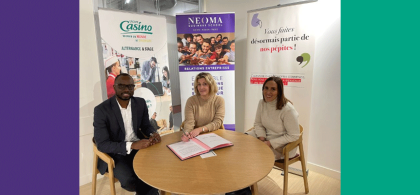
The place of disability in business: 4 partners in action
23/01/2025
How NEOMA and its partners are coming together in training for managing diversity

Since 2015, Grand Reims has asked researchers at NEOMA to propose projects related to territorial attractivity.
Through this funding, the Grand Reims community has become the ground for observation, experimentation, and the production of academic knowledge, all of which is relevant for local decision-makers, with a view to designing and deploying actions aimed at making the Reims area more attractive.
by Gaël Bonnin
The use of artificial intelligence is a major issue for a lot of economic players. The objective of this project, which combines qualitative and quantitative study, is to evaluate how artificial intelligence can contribute to developing the local economy. It concerns evaluating the use of artificial intelligence by the industrial and agricultural sectors, identifying the obstacles and motivations in adopting it and the impact on the development of different businesses.
COVID-19 has heavily impacted the activity of businesses, with e-commerce seeing considerable expansion during the lockdowns. This project seeks to identify the different ways out of the crisis and the strategies to implement in order to revitalise in-store traffic. A study will be conducted with various retailers (situational analysis of the use of different digital strategies and their associated difficulties) and another with consumers (attitudes towards city-centre businesses and remote businesses). Students will also be given the problem to review as part of different courses and activities. The results of this research will be offered up in a report and as presentations for any interested businesses.
Based on the collected online data, we produced a longitudinal analysis of wine consumption among the French (2014 vs 2020 vs 2021). This collaborative study conducted by NEOMA Business School and Grand Reims shows the major behavioural changes among the French towards wine. Overseen by the researcher Nathalie Spielmann, this longitudinal analysis helps us understand how the habits of French consumers regarding wine have changed over the last seven years as well as before and after the COVID-19 crisis. This study includes three periods and represents an overall sample of more than 3,000 French consumers. More specifically, it looks at an initial data collection in June 2014 involving 1,051 consumers, a second collection in February 2020 involving 1,038 consumers and finally a collection in May 2021 involving 1,121 consumers.
Titled SYNNOVATE, this project seeks to help local SMEs take advantage of the Open Innovation programme to overcome their problems associated with the Covid-19 pandemic. To do this, expert-led periodic seminars for managers will be organised to raise their awareness about how they can access this initiative. At the same time, a survey will be conducted to analyse the problems that SMEs have encountered and prioritise the challenges they need to meet. Lastly, based on the survey results, practical workshops on identifying and selecting partners and managing the Open Innovation process will be offered. Eventually, the efforts will concern involving local SMEs in a community of practices that help build shared resources and establish collaborations that will allow them to become fully involved in the Open Innovation initiative.
Proposed by Dr. Nathalie Spielmann (Associate Professor in the Marketing Department). The main objective of this project was to . Through the lens of telepresence – i.e. the cognitive state of feeling like you are in a place without leaving home – Dr. Spielmann was able to show that 360° tours lead to increased positive attitudes towards the product or service offered online. Since 2015, Dr. Spielmann has continued to work with the city of Reims on this topic, and on many others. She has shown, via her research, that 360° tours are more powerful than videos and static images, how such online offers should be designed, and how enabling telepresence leads to more authentic perceptions of advertisers, as well as decreased perceptions of manipulative intent. Spielmann and her co-authors have also examined:
COWAN, K. L., SPIELMANN, N., HORN, E., GRIFFART, C. (February 2021) Perception is Reality… How Digital Retail Environments Influence Brand Perceptions through Presence. Journal of Business Research, vol. 123, pp. 86-96
COWAN, K. L., SPIELMANN, N. (December 2020) Culture is in the “I” of the Beholder: Identity Confirmation in Tourist Advertisements. Journal of Business Research, vol. 121, pp. 378-388
SPIELMANN, N., MINTON, E. (December 2020) Representing Another Nation: The Influence of Foreign Citizen Ambassadors on Product Evaluations. Journal of Business Research, vol. 121, pp. 409-419
SPIELMANN, N., ORTH, U. (June 2020) Can Advertisers Overcome Consumer Qualms With Virtual Reality? Increasing Operational Transparency through Self-Guided 360-Degree Tours. Journal of Advertising Research
GOMEZ, P., SPIELMANN, N. (July 2019) A taste of the elite: The effect of pairing food products with elite groups on taste perceptions. Journal of Business Research, vol. 100, pp. 175-183
SPIELMANN, N., BABIN, B., MANTHIOU, A. (September 2018) Places as Authentic Consumption Contexts. Psychology and Marketing, vol. 35, no. 9, pp. 652-665
SPIELMANN, N., MANTONAKIS, A. (July 2018) In Virtuo: How User-Driven Interactivity in Virtual Tours Leads to Attitude Change. Journal of Business Research, vol. 88, no. 2, pp. 255-264
SPIELMANN, N., GOMEZ, P. (2017) Snobby = Tasty? How Product Elitism Influences Taste Perceptions. Society for Consumer Psychology Conference, San Francisco, United States
23/01/2025
How NEOMA and its partners are coming together in training for managing diversity