

- Responsible purchasing: develop a fleet of refurbished and second-hand computers.
- Meals and catering purchases: reduce the proportion of meat‑based dishes.
- Energy: buy more renewable energy and cut costs through greater energy efficiency.
- Student travel: expand the use of train and bus travel for academic mobility in Europe.
- Travel arrangements for faculty and staff: increase the use of trains for inter-campus travel, prioritise fleet vehicles and encourage carpooling.

NEOMA’s environmental commitments
NEOMA has adopted a “sustainable campus” strategy that includes concrete actions for reducing our carbon footprint, respecting the environment and protecting biodiversity.
Carbon footprint audit and transition plan
NEOMA published its Greenhouse Gas Emissions Report (BEGES) in 2024. In the 2022-23 benchmark academic year, the School emitted 17,000 tCO2e.
NEOMA is committed to achieving Net Zero for Scope 1 and 2 emissions by 2030, while continuing to develop policies to reduce Scope 3 CO₂ emissions with the goal of reaching Net Zero by 2050, using 2019 as the baseline year. The school is certified as a 'Net Zero Contributor' by Greenly.
Over 2022-2024 three years period, thanks to policies established and awareness campaign, total energy consumption of heating and cooling system and showed an overall decline of about 8%. Planned energy efficiency upgrades will continue thanks to Reims New campus, the entire building will be connected to a geothermal plant using a phreatic aquifer, the first of its kind in France which will lead to significant CO2 reduction. This new real estate project aims to achieve internationally recognized certifications and labels, such as LEED, WELL, and E+C-.
In addition, as an academic commitment, the NEOMA faculty dedicates more than 100,000 hours a year to training undergraduate and graduate students on topics related to sustainability.
Our transition plan, overseen by the NEOMA SET Management Committee, identifies five key action areas for cutting the School's emissions.
THE “GREEN MOBILITY” BONUS
This initiative encourages our students to act responsibly when traveling for academic exchanges or internships.
As well as providing a Guide to Sustainable Practices, the School subsidises part of the transport costs for anyone who chooses an eco-friendly mode of transport (train, carpooling or long-distance buses).
Examples of NEOMA’s environmental initiatives
Campus HQE certification: NEOMA is committed to campus renovation and construction that respects key environmental requirements.
Raising staff awareness of responsible digital practices: NEOMA runs a “Digital Clean-up Week” as well as email‑inbox clean‑up workshops.
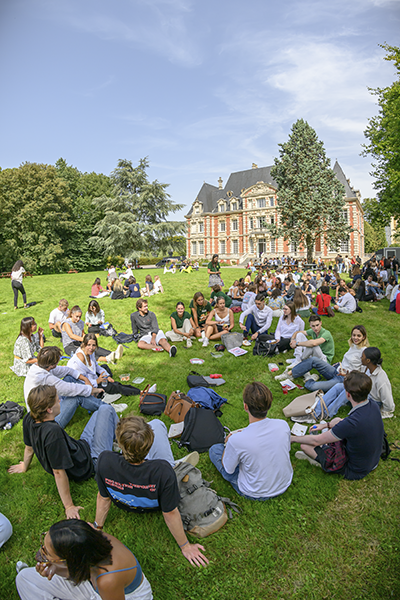
Biodiversity inventory: From spring 2026, this inventory will be carried out each season on the Rouen campus for the School to draw up an accurate list of all living species on site to safeguard their preservation and highlight their value.
Biodiversity fresque-style workshop: we train our students in biodiversity-related issues.
Beehives: the School plays an active role in enriching urban biodiversity by installing beehives on the Reims and Rouen campuses. In addition, the Rouen student association Bee Responsible leads initiatives designed to protect bees in urban areas.