


Diversity, equity, inclusion: the temptation to pull back
29/07/2026
What strategies do companies adopt in response to criticism of their DEI policies? Our students’ responses.
NEOMA’s world

Published on 15/10/2026
Research at NEOMA involves a community of 250 professors, all experts in their respective fields, each working at the cutting edge of knowledge and striving to push back the boundaries of what we know. With this in mind, we’ve created four* areas of excellence so that professors from different disciplines – such as entrepreneurship and finance, supply chain and marketing – can work together using complementary research methodologies. Some professors use more quantitative methodologies that draw on statistical analysis, while others favour more qualitative approaches based on interview data and field observations.
Yes, it is. We’re working with our Impact Officer, Jean-Baptiste Suquet, to make sure that our research doesn’t just result in academic articles but that it also leads to real‑world progress and tangible outcomes. That’s why we make a point of disseminating recommendations based on our research across the regions where we operate, as well as with the general public, entrepreneurs, businesses, other stakeholders and public-sector bodies. We organise meetings and seminars for industry professionals. And we can also answer some of the specific questions they may have.
Of course. Take Reims City Council, which asked us to help them set up a “bureau du commerce”, a municipal office dedicated to supporting local business. We were able to get involved very early on by reviewing all the offices that were working well in France. We studied this model in around 30 cities, analysing how the various stakeholders had been brought together to collaborate on these projects. These included chambers of trades, chambers of commerce and industry, training centres and retailers’ associations. It also involved municipal and metropolitan services tasked with supporting entrepreneurs looking to set up in their region. The project drew on expertise from researchers in human resources, logistics, accounting, marketing and organisational theory.
Yes, very much so. We have a relatively new field of research that focuses on organisations made up of other organisations, known as “meta-organisations”. And this bureau is a case in point: we’re bringing together organisations that aren’t always used to working together within a structured framework, including trade associations, chambers of trades, chambers of commerce and industry and Bpifrance. And we're trying to build an organisation, this bureau du commerce, that unites them all. We're trying to understand what makes these initiatives successful, and we’ve been able to test our approach in a physical space. So yes, from a research point of view, it was exciting for us to see the emergence of a meta-organisation.
We’re particularly interested in how AI is revolutionising the way we learn, both in schools and when people start their first jobs. To make this more concrete, let’s take the example of an audit. Before AI, young graduates spent the first three years of their professional lives on tasks designed to help them understand the profession, such as handling accounting work. With the emergence of AI, many of these tasks can now be automated. Our first question is: how can we transform the way young people learn? How can we embed these learning processes in the school curriculum to prepare them better for the world of work? The challenge isn’t just to teach the young generation how to use these AI systems but also how to understand them and stay in control. The big question, too, is: what will AI actually be used for? And here, we're only at the very beginning. We're only just starting to understand what new services and what new jobs will emerge. For us, AI is a very exciting technological revolution.
Yes, absolutely. That’s why we’re currently working with Alain Goudey, our Associate Dean for Digital, to establish an AI research institute as part of a broader €15 million programme to transform NEOMA over the next three years. The aim is to create different chairs within the institute, focusing on research, impact projects and teaching methods.
AI can help with data processing. It's an upgraded version of the econometric tools we already had, and it helps us explore the literature more quickly and in more depth.
Previously, there was quite a long gap between the start of our research, theoretical discoveries and their translation into practice. Today, we can use AI to compress this time-frame and deliver impact much more quickly. Impact is of vital importance; that's what our research is all about. We're helping to make this world a better place. Faster and stronger.
The danger is surrendering our intelligence wholesale to AI. We need to remain vigilant: just because this technology exists doesn’t mean we should stop reading the scientific literature or exploring it on our own. We have to carry on taking the time to read these articles, to make mistakes, to lose ourselves in the literature. Getting a bit lost, especially during training, is important. The risk would be to use AI all the time, for everything, and rely on it blindly, to stop thinking for ourselves or engaging in human interactions, contentious discussions and disagreements. That would be a disaster. Another danger would be to delegate the assessment of scientific rigour entirely to AI.
Yes, more than ever. Look at the summer temperatures: climate change is a reality. NEOMA is approaching this new reality with a fundamentally optimistic outlook on our ability to turn things around. Alongside our Dean, Delphine Manceau, we're actively pushing back against fatalism, against nihilism, against the idea it's all over, that the world is hurtling towards disaster and it’s too late to reverse the trend. We're not only working to limit the effects of climate change, but also to cultivate a mindset that will encourage the development of new technologies and groundbreaking innovations that can help us mitigate climate change effectively. We shouldn't view IPCC reports fatalistically, as forecasts of a future we can’t do anything about. We should see them as a warning of what lies ahead if we simply stand by. It’s vital that we never lose faith in our collective ability, especially that of younger generations, to tackle obstacles and push past them. We'll be amazed at what we can achieve. Our students will surprise themselves. We’ll innovate in ways we can’t yet imagine. We're building bridges, particularly with engineers. We will reverse the course of climate change. That’s our deep conviction. And we’re tackling it head‑on. We’re taking an optimistic, action-oriented approach. But it may take time, which is why we're also working on designing economic and organisational models that will enable us to reduce our impact on our ecosystems.
* The Future of Work; The World We Want; The Complexity Advantage; AI, Data Science & Business
29/07/2026
What strategies do companies adopt in response to criticism of their DEI policies? Our students’ responses.
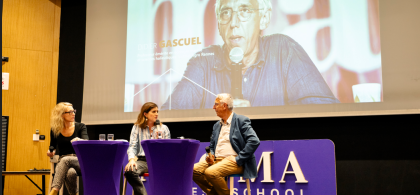
02/10/2026
To mark the start of the new academic year, students took part took part in two days of lectures and group work.

Antoine SOUCHAUD is Associate Dean for Faculty and Research since June 2026. He is Full Professor at NEOMA Business School and Ecole Polytechnique. He has been the Head of the Accounting, Controlling and Legal Affairs academic department from April 2022 to August 2026. Antoine’s research interests