
“NEOMA has taken its place on the world stage”
05/10/2026
By 2026, NEOMA had significantly expanded its global network of partners.
NEOMA’s world

Published on 12/06/2026
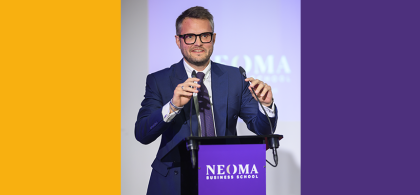
Michel-Édouard Leclerc, NEOMA’s President since 2018, was reappointed for a further four-year term in January. It was the perfect opportunity to discuss his vision and ambitions for the School.
How would you assess the situation since taking over as head of NEOMA?
The first thing to say is that this mandate as President is a great honour. I love the students at this School. I love working with the administrators, professors and other staff, and I think we form a really complementary team with Delphine Manceau, the Dean. I’m delighted to be signing on for another four years. I will approach this second term with the same energy, the same determination and the same enjoyment as always.
NEOMA has made tremendous strides in the past few years. We’re building momentum not just in the league tables, of course, but also more widely. Several core initiatives are driving the School forward, including the opening of a new campus in Paris in 2021 and the soon‑to‑open Reims campus. Then there are the new partnerships we’ve signed with big-name companies and the new alliances we’re building in France and internationally. We are also making advances in research and integrating climate‑change issues. Finally, we have been rolling out a large‑scale AI training plan for students, faculty and other employees.
But when all is said and done, what really matters isn’t the number of projects; it’s the momentum they generate. I am determined to carry on serving NEOMA in this same spirit.
In practical terms, what role are you playing in this process?
At the beginning of my first term, I was afraid I’d be asked to serve as an “Honorary President”, which wouldn’t have interested me. I’m still very much in touch with what’s happening on the ground, and my goal is to be useful, to put my network and my experience to good use for the School.
I see myself as a facilitator, a unifier, a catalyst. I don’t interfere with the academic programmes or educational content. But a few years ago I did suggest launching a series of conferences on social responsibility. My aim is to give students the opportunity to engage in high-level discussions and debates with leading figures and thinkers from the worlds of business, society and culture.
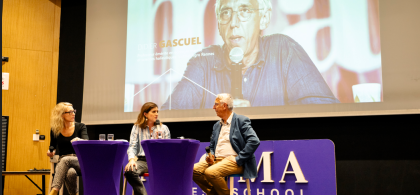
It’s a commitment that comes naturally to me, given the importance I attach to the humanities and the social utility of organisations. Working with the School’s staff, we identify potential speakers and reach out to them. We’ve been fortunate to welcome senior leaders to our Reims and Rouen campuses, including Emmanuel Faber, former CEO of Danone; Sébastien Missoffe, CEO of Google France; Frédéric Duval, CEO of Amazon France; and Thierry Cotillard, President of the Les Mousquetaires Group. We’ve also welcomed a wide range of other speakers, including Professor Bruno Dubois, a world‑renowned expert on Alzheimer’s; Philippe Besson, one of the most widely read French authors of his generation; and Jean‑François Julliard, former CEO of Greenpeace France.
We want to equip students with the tools they need to understand the complexity and analyse the role they’ll be playing as future business leaders. In the same vein, I have also worked on the partnership between NEOMA and IRIS at the interface of geopolitics and management.
I’m a hands-on President, and agreeing to take on this role means I’ve also become a student once more, listening and ready to learn.
What skills should a school like NEOMA instil in its students to prepare them for today’s challenges?
Nowadays, being a “good student” is no longer enough to succeed. You have to understand the world as it really is, not as you would like it to be. So yes, solid technical skills, of course, are important, but more especially analytical thinking, curiosity and the ability to make decisions in the midst of uncertainty.
I see it clearly on the ground: we need profiles who can challenge what seems obvious, collaborate with people who think differently and test ideas against real-world conditions. A school like NEOMA should produce well-formed minds, not merely well-filled ones.
Educating young people is critical in ensuring France’s competitiveness and long-term future. It's a thrilling mission, and at the same time, what a responsibility! But I’m very confident. NEOMA is tackling the next phases of its development with ambition, driven by large-scale projects and a clear priority: to educate students who are open to the world, ensure their long‑term employability and provide support so they become positive contributors to society.
What advice would you give to NEOMA students today to help them get the most out of their education?
I wouldn't try to tick every box for a flawless career path. I’d say: go where the action is, where things are a bit disruptive. I would get as many different experiences as possible: internships, international stays and getting involved in student clubs or societies. And most of all, I’d expose myself to new environments.
Understanding customers, the public and local communities isn’t something you only learn in the classroom. Studying isn’t about following a blinkered path; it’s about opening up space for exploration. Students should use their time at NEOMA to get to know themselves better, build resilience and gear up for change. Even if the world isn’t waiting for them, it’s still made for them, and I’m very optimistic.
What role can an alumni network like NEOMA's play in shaping career paths today?
A network isn’t just an address book; it's a responsibility. It is a vibrant, supportive and active community. Needless to say, it can open doors, but first and foremost it should foster mutual support and knowledge‑sharing. As careers become longer and less predictable, you can’t move forward on your own.
The people who succeed are often those who not only know how to leverage their network, but also how to cultivate it. A good network isn’t a network you turn to in times of need, but one that you actively maintain at all times. And when young graduates themselves become “old hands”, they reinvest this capital and give back by helping, recruiting and mentoring… It’s a very powerful dynamic!
If you had to share one personal message to send to the NEOMA community, students and alumni alike, what would it be?
I would like to tell them that I am proud to be the President of this School. NEOMA is more than just a name; it’s a symbol of openness, curiosity and multidisciplinarity – key qualities for staying innovative as managers. That's our ambition for our students. It's great if I’ve been able to provide a positive, meaningful reference to help bring their plans to life, even if it's just one line on their CV. And if, at some point, the School can help open a door for them, then we will have done our job.
05/10/2026
By 2026, NEOMA had significantly expanded its global network of partners.
02/10/2026
To mark the start of the new academic year, students took part took part in two days of lectures and group work.