


Master in Management
With the Master in Management become a top-level business leader, capable of meeting the expectations of organisations all over the world.
2 to 3 years
NEOMA’s world
Published on 11/09/2026
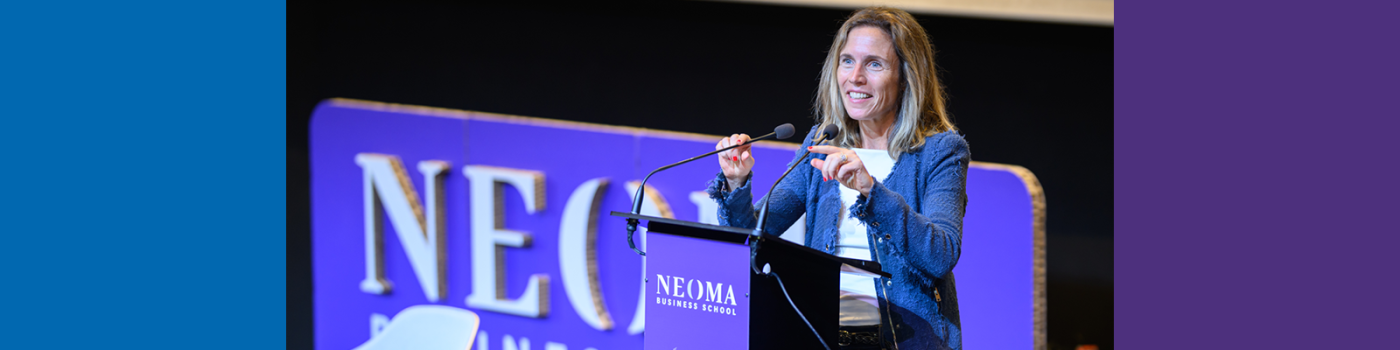
Lesson 1: “Your career won’t follow a straight line.”
Justine reminded students that her career had been anything but straightforward. She started out with a year at medical school before realising it wasn’t for her. She then went on to complete a BTS vocational diploma, which took her to NEOMA, then still known as Sup de Co Reims. She later moved to Argentina to pursue a double-degree programme at the University of Belgrano in Buenos Aires. What was meant to be a six-month stay turned into two years. Justine subsequently went to work for the “Netflix of Latin America”.
A crisis in Argentina in 2000 prompted Justine to return to Europe via Spain, where she joined a mobile and digital services company, which ultimately led her to Endemol (an audiovisual production firm) in 2003. She then moved into content, and the social network Twitter came calling in 2013. Justine made her way to Silicon Valley, a move that proved pivotal for her career. In 2017 she took up a leadership position at YouTube, where she began working closely with the world of online video creation. In a nutshell, nothing to do with medicine!
Lesson 2: “Don't ask for permission: claim your space.”
“Your legitimacy shouldn’t depend on someone else’s approval. You earn it through who you are, through what sets you apart and through the work you put in. The more I work, the luckier I get,” explains Justine. “What makes you different can be a real strength. Look at today’s YouTube creators: the most successful ones are often those who cultivate a distinctive voice of their own. But this uniqueness always comes with hard work, discipline and collaboration. And then I’d also urge you to embrace what’s called Kaizen, the practice of continuous improvement.”
“During my time in Silicon Valley (and it’s something I still say every day at YouTube), I learned the importance of rapid iteration. If you wait until you’re completely on top of something before getting started, you’re already too late. The biggest leaps in my career have happened when I was only halfway ready. At most. Everything else, I learned by doing, facing reality, accepting that I would stumble along the way. And stumbling is part of learning.”
Lesson 3: “Don't fixate on tools or working methods.”
“Learn to identify and solve real problems. What does that mean? Your generation already has access to unprecedented technological power, and it will have in the future. And with that power comes a particular responsibility. Here, as we’ve said, you will learn to analyse, persuade, negotiate and lead. But none of these skills will count unless you give them a purpose.”
“In my day-to-day work, and in the tech world more broadly, in Silicon Valley, I see hundreds of technological trends come and go. I see countless rounds of flashy fundraising. I hear really enticing pitches for solutions, but sometimes they don't address any real need. The projects that last – I’d even say the leaders who leave a real legacy – aren’t the ones who run after the latest tech trend. They’re the ones who start by asking the question: what’s the problem that needs solving? All types of technology, starting with AI, are just tools. The sense of purpose, ethical vision and human empathy, all of that depends entirely on you.”
Delphine Manceau, our Dean:
“A cohort mentor has a real role to play in supporting and guiding students. It’s a window onto the world of work. It’s about being a role model, as they say, a point of reference, and – I hope – a source of inspiration for you.”
31/08/2026
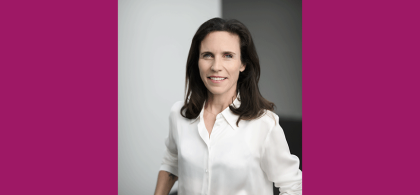
Justine Ryst, Director of YouTube France will be the patron of the PGE intake for the 2026 academic year.
06/02/2026
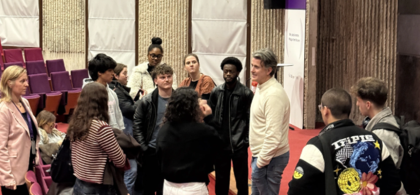
The graduate met with our students on the Reims campus. Highlights.