


Higher education faces the challenge of artificial intelligence
28/08/2025
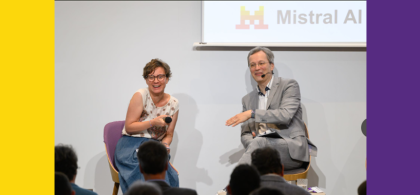
NEOMA and Mistral AI organised a morning seminar devoted to AI in June, and here we take a look back in pictures.
NEOMA’s world

Published on 20/04/2026
Gilles Babinet, founder of CafeIA, set the stage: “AI isn’t just another trend. It’s a disruptive technology on a par with the advent of electricity or the internet. But with one sizeable difference: it’s exponential. AI is self‑improving, fast forwarding progress in fields as diverse as health, materials science and energy, making it especially difficult to predict its impacts.” Babinet suggests that, even if Europe is roughly two years behind, it’s by no means out of the game. Regulation, which is often viewed as a hindrance, could actually become a competitive advantage. Much like the automobile industry, where productivity only really took off once common standards were introduced — the highway code, for example, or driving licences and fuel standardisation — AI will only unlock its full potential within a stable regulatory framework. “Our model is far from being a failure; it’s a success that’s going unnoticed,” added Babinet.
For Alain Goudey, associate dean for digital at NEOMA, this new reality calls for a clear strategic stance: “AI is genuinely the new grammar of economic performance,” he says, while emphasising an important nuance: these tools are meant to augment our thinking, not replace it.
Laurent Boyer, co-founder of Allo.IA, described a structural shift that is often underestimated: “AI is inserting itself between businesses and their customers. We’re moving from traditional search engines — where you click on a link — to answer engines that deliver a decision directly. Value is now being created upstream of the click, which is radically redefining marketing, customer relations and business models.”
Claire Mathieu, data and AI director at Suez, illustrated this transformation with an example from industry: “In water and waste management, AI means it’s already possible to predict how factories will behave in response to extreme weather events, anticipate resource trends and make better sense of waste flows. It's no longer an experimental: it has become strategic, provided that workforces receive the training and support they need to understand how their professions are likely to evolve in the future”.
Philippe Barbet, an associate researcher at IRIS and professor emeritus of economics at Sorbonne-Paris-Nord University, highlighted the American dominance across the AI value chain. A handful of US players occupy near-monopoly positions at every stage, including components, cloud infrastructure and models. The American company and global leader NVIDIA accounts for roughly 95% of the market for AI‑dedicated chips, while Amazon Web Services, Microsoft Azure, and Google Cloud dominate the cloud sector. And across the six or seven major language models on the market, almost all are American.
Faced with this dominance, China is implementing a long-term catch-up strategy: it now files more AI-related patents than the US, and its homegrown chips could match NVIDIA's level within two to three years. The China-US rivalry hinges on well-defined chokepoints (chip fabrication, rare earths and patents) with direct consequences for worldwide geopolitical balances.
Marie Garin, a CNRS postdoctoral researcher, drew a parallel with the lobbying strategies deployed by the tobacco companies in the 1960s. “The tech industry employs around 890 full‑time‑equivalent lobbyists in Brussels — more than the number of Members of the European Parliament. That’s three meetings per working day with representatives of the Commission or Parliament.”
This view was echoed by Charles Thibout, an associate researcher at IRIS whose dissertation focuses specifically on GAFA lobbying: “This model was built on importing the legal methods of the US tobacco industry, most notably at Microsoft, which hired the tobacco firms’ lawyers on a huge scale after its antitrust trial in the 1990s.”
But Marie Garin added this caveat: “The major digital companies aren’t just pursuing traditional political lobbying; they’re actively shaping the production of AI knowledge by heavily funding academic research, especially in the field of AI ethics”.
Pascal Boniface, director of IRIS, brought the debate to an end: “Be on your guard, but don’t be afraid. The revolution is here, and there’s no hiding from it.” Doing nothing, by contrast, is a losing strategy: countries that let the Industrial Revolution of the 19th century pass them by paid the price for 100 years.
In terms of jobs, Boniface observed that the countries that have invested the most heavily in robotics and AI have not seen higher unemployment, which undermines the case for a protectionist retreat. The real issue is more about how to navigate this transition: by connecting technological progress with social justice, rethinking redistribution mechanisms and converting regulation into a lever rather than an obstacle.
Even highly skilled professionals — such as lawyers, doctors and teachers — are not immune. They are being challenged. There are things that AI won’t be able to do: argue a case persuasively, offer a patient reassurance or guide a student through the complexities of their thought process. But AI will mean that we can spend less time searching for information and more time placing it in context.
Who is Laurent Boyer, NEOMA graduate and founder of AlloIA?
With a background in engineering and management, Laurent Boyer (Master in Management, 2013) began his career abroad in Switzerland and Canada, working in project management and business development in the IT and AI sectors. On his return to France, Laurent co-founded AlloIA, a French-Canadian start-up dedicated to supporting online retailers in the age of AI and agentic commerce.
“AlloIA’s role is to help brands make sure their products are fully understood, cited and recommended by AI systems as the web undergoes major changes”, explains the NEOMA alumnus.
“Traditional SEO and online reputation are no longer enough to stand out in AI-driven responses. When conversational agents like ChatGPT, Mistral or Perplexity look for information about a product, they run into ecommerce websites built for human users, which results in incomplete or ambiguous access to data and contributes to AI hallucinations.”
This is where AlloIA steps in, making structured data available to AI systems. “Brands can then reclaim their status as official sources of truth in the eyes of AI systems and are naturally recommended”, continues Laurent. AlloIA is already working with several agencies and online retailers in France and Canada. The startup is planning a fundraising round in 2026 to fast-track its growth.
28/08/2025
NEOMA and Mistral AI organised a morning seminar devoted to AI in June, and here we take a look back in pictures.

06/04/2026
Conferences and workshops to rethink teaching methods in the age of artificial intelligence.