

Preparatory classes and artificial Intelligence: the 5 lessons to take away from a day of reflection
18/04/2025
NEOMA and APHEC brought together teachers from preparatory courses to explore artificial intelligence.
NEOMA’s world

Published on 06/04/2026
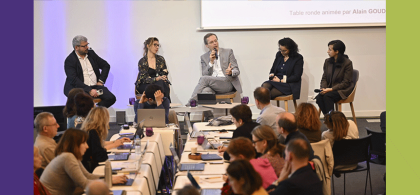
In late March, over 100 preparatory class teachers gathered on NEOMA Business School’s Paris campus for a day of conferences and hands‑on workshops dedicated to the latest developments in artificial intelligence. The aim of this second NEOMA AI day was to rethink teaching practices in concrete, practical ways. Below are the three key insights that emerged.
AI is evolving at a phenomenal rate. In the space of one year — sometimes in a matter of weeks — models can double their performance, and traditional measurement tools can no longer keep pace. These “benchmarks,” which are meant to test the limits of AI systems, are being swamped so quickly that experts must constantly devise new evaluation tools.
In March 2026 alone, Mistral, NVIDIA, OpenAI and Anthropic each announced major breakthroughs. The scale of this acceleration exceeds anything we experienced in the early internet era.
“I’ve been working in digital transformation for 25 years,” says Alain Goudey, associate dean for digital and a professor at NEOMA, “and the pace of AI development is on an unparalleled scale.”
AI tools are evolving so rapidly (sometimes from one week to the next) that no lecturer can stay on top of every new model or feature. It’s a losing battle from the outset. It’s more important to understand why everything is changing, where it’s heading and what the implications are for teaching practices.
Knowing how to formulate the right question
Until now, the most important skill has been the ability to memorise and retrieve knowledge. But today, anyone can find information in seconds. The real distinction lies in the ability to ask the right question.
A precise, contextualised and well‑structured prompt generates a useful response; when the prompt is vague, the response is equally vague. AI is not inherently intelligent: it amplifies what it is fed. Formulating a good question is in itself a way of organising your thought process.
Learning how to check information
AI is capable of producing answers that are perfectly packaged and rigorously referenced… and totally false. It conjures up researchers who have never existed, cites studies that have never been published and delivers information that is totally wrong with great confidence. But the problem isn’t that AI makes mistakes; it’s that it makes them with the same confidence it shows when it’s correct.
In this context, the core competency is no longer knowledge itself; it’s the capacity to doubt, analyse and validate.
“The core competency is no longer knowledge itself; it’s the capacity to validate,” explains Jérôme Ony, professor and curator at NEOMA.
The educational challenge is to help students make the move from the first level to the next two.
The facts speak for themselves: 73% of students nowadays use AI for their assignments. In preparatory classes, the figure almost certainly rises to 100%. And yet, the way exams are organised continues as if AI didn’t exist.
Most assessments still require students to recall knowledge, summarise ideas, create a plan and write an introduction. But these are exactly the kinds of tasks that AI excels at! Students today can hand in a good piece of work without having really thought about it, understood it or worked on it.
“It is more likely that AI will lower the level of the top students and artificially raise the level of the weakest,” explains professor Goudey.
What AI cannot do, however, is form a personal point of view, defend a position when challenged, recognise when a line of reasoning reaches its limits or exercise real judgment.
The teaching approaches championed by NEOMA
In response to these transformations, NEOMA is advancing an approach based on the following teaching principles:
AI as a mirror
AI is exceptionally effective at recalling knowledge, summarising an argument, structuring a conventional essay plan and writing a standard introduction. So, if it can answer a question easily and effectively, it means the question does not require any additional skills.
By contrast, if the AI struggles to answer the question, circles back or produces a superficial response, it’s a good sign: it means that the question requires something the AI cannot provide — a personal perspective, a judgment, a lived experience or the ability to resolve a counter-argument.
In short, a good exam question is one that AI struggles to answer.
AI as a first draft
AI produces an initial draft. The student pinpoints the weaknesses, challenges the AI about inaccuracies or poor structure… and then rewrites, improves and transforms this draft, in the process becoming the editor. This is where the intellectual work begins.
AI as a partner
The student puts forward an idea and asks the AI to defend the opposite position. They enter into a dialogue: ideas are compared and contrasted, arguments tested and the line of reasoning strengthened. AI does not impose a way of thinking; it forces the student to develop their own.
The same rule applies in each of these three cases: AI amplifies what the student is already capable of doing. A passive student will still be passive in response to AI. A curious, engaged student will become a better student.
“We don’t train accurate recall anymore. We’re training minds capable of doubting, questioning and standing firm against easy answers”.
18/04/2025
NEOMA and APHEC brought together teachers from preparatory courses to explore artificial intelligence.

30/05/2025
Can artificial intelligence be used in the service of academic excellence? A Humanities teacher answers.