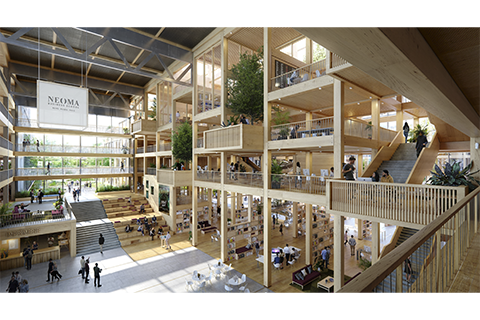


An "in-person only" three-day mini-Conference, kicked off with a methodological workshop.
Two keynote speakers and two invited guests will present their work that corresponds to the topic of the event and help with the development of the invited papers.
The papers will be selected on the basis of their abstract (fit to the conference topic, overall theoretical and methodological quality). Participants whose abstract has been accepted are expected to present their papers at the conference.
The emphasis will be on research projects in the developing stages.
The invited guests and keynote speakers will also help make the selection for the best paper award.
The topic of our 5th anniversary leadership mini-conference is Leadership and Sustainability in the Workplace. We define sustainability broadly based on the United Nations’ Sustainable Development Goals (United Nations, 2015), in particular good health and wellbeing, quality education, gender equality, decent work and economic growth, reduced inequalities, climate action, and peace, justice and strong institutions. Achieving these goals poses leadership challenges for leaders on different levels of the organisational hierarchy as well as followers’ leadership relevant actions.
Many of these goals are realised, or undermined, in everyday interactions between leaders and their teams. Leaders influence whether employees act in an environmentally sustainable way at work, through their own behaviour, and the context they create for their teams (Zacher et al., 2023, 2024). Leaders can be a valuable asset or a significant risk to their employees' well-being: positive leadership is linked to increased work engagement and reduced burnout, while negative leadership exhibits the opposite trend (Pletzer et al., 2024). Importantly, neither leadership nor well-being is static. Leadership, including shared leadership among team members, fluctuates from day to day and is linked to collective well-being over time (Klasmeier & Lehmann-Willenbrock, 2024). This highlights the need for a consideration of what makes leadership and the well-being of those involved sustainable.
Workplace sustainability also encompasses the social and ethical aspects of organizational life that are closely related to leadership. Demographic changes and ageing workforce raise questions about whether employees can stay healthy, motivated, and employable throughout their working lives and how leaders can help them achieve this (Zacher, 2015). Gender and ethnic equality remains a pressing issue in terms of diverse representation in leadership positions (Goryunova & Madsen, 2024; Zhang et al., 2025), as well as in the ongoing debate about the "business case" for gender equality (Pletzer et al., 2015). Additionally, there are challenges that female and minority leaders face in their interactions with their teams (Preston et al., 2024; Van Gils et al., 2018). The quality of the employment relationship is also crucial for decent work. This includes whether organisations honour their commitments to employees, how employees respond to job insecurity (Costa & Neves, 2017; Coyle-Shapiro et al., 2019), and how leaders can influence organization-employee relations. Finally, strong and just institutions require ethical leadership; however, the impact of ethical and unethical leadership is not uniform and may be shaped by followers themselves (Kim et al., 2024; Van Gils et al., 2015).
In sum, achieving sustainability goals poses challenges for leaders at different levels of the organizational hierarchy. It also highlights the active role of followers, whose leadership-relevant actions can either foster or hinder sustainability. With this broad framework, our aim is to bring together scholars from various fields of leadership and followership research, and stimulate discussion on how leadership can contribute to sustainable workplaces for people, organizations, and society.
Interested participants must submit an abstract by January 20st, 2027 via the following link: https://neoma.eu.qualtrics.com/jfe/form/SV_41SCD0LoluJD9Xw
The abstract should be of no more than 1,000 words (including references). Authors will be notified of acceptance or otherwise by February 16th 2027.
Additionally, the participants can submit a working paper version of their abstract (voluntary) by March 22nd, 2027.
Detailed programme will be downloadable here in March.
In short:
14.00-16.15 Welcome and Method workshop
17.00 Champagne house visit
19.00 Welcome dinner
9.00 to 10.15 Keynote
10.15 to 10.30 Coffee break
10.30 to 12.30 Sessions
12.30 to 14.00 Lunch
14.00 to 16.00 Sessions
16.00 to 16.15 Coffee break
16.15 to 17.15 Data collection panel discussion
9.00 to 10.15 Keynote
10.15 to 10.30 Coffee break
10.30 to 12.30 Sessions
12.30 to 14.00 Lunch
14.00 to 16.00 Sessions and closing
Urszula Lagowska (NEOMA Business School, France), PhD, is an Associate Professor, Department of People and Organisations.
She holds a PhD in Management from Brazilian School of Public and Business Administration in Rio de Janeiro (FGV-EBAPE).
Her research is aimed at understanding the impact of various forms of leadership and identity processes on well-being and performance.
Her work has been published in journals like Journal of Applied Psychology and Public Administration Review.
She serves as Consulting Editor for Psychology of Leaders and Leadership.
Iris Gauglitz (NEOMA Business School, France), PhD, is an Associate Professor, Department of People and Organisations.
She holds a Ph.D. in Psychology from University of Bamberg (2021).
Her research centers on leadership - particularly abusive supervision, and the dark triad at work, with a focus on narcissism among
both leaders and followers.
Her work has been published in journals such as the Journal of Business Ethics, the European Journal of Work and Organizational
Psychology, and Journal of Personnel psychology.
She serves as a Consulting Editor
for Psychology of Leaders and Leadership.
Birgit Schyns (NEOMA Business School, France) is Professor in Organisational Behaviour, Department of People and Organisations.
Her research focus is leadership, particularly the follower side of leadership as well as the dark side of leadership.
Birgit has edited several special issues and four books. She was associate editor for the European Journal of Work and Organizational Psychology (until 2011), the British Journal of Management (until 2013) and Applied Psychology: An International Review (until 2020).
Birgit serves on several editorial boards.
Register will open on the 17th of February 2027
Last day to register: April 15th, 2027
Please note that the regular participation fee is 150 euros and 100 euros for students, to cover conference costs.
Coffee-breaks and lunches during the conference are included.
Paper presenters and participants will need to cover their travel and accommodation.
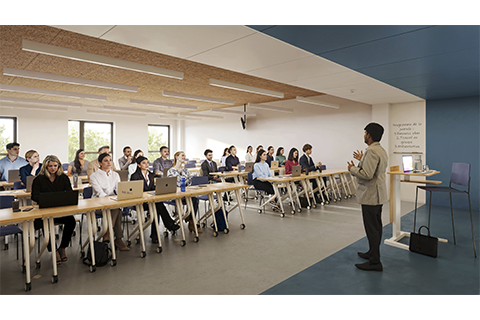
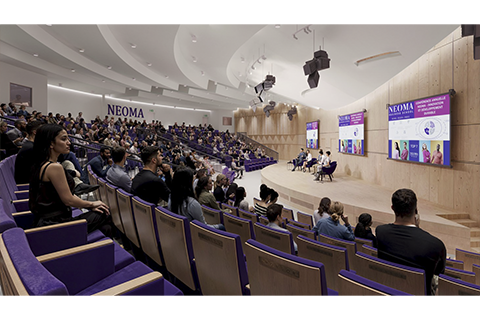
NEOMA will inaugurate its new Reims campus in early 2027.
Located at 15 minutes from Reims station.
Detailed information will be available here beginning of 2027.
For any questions about the event, please contact the organisers:
Birgit Schyns
Professor