


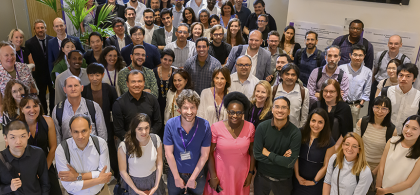
NEOMA professors among World’s Top 2% Scientists
15/10/2026
Stanford University published its 2026 ranking of world’s top 2% most influential scientists from all areas
NEOMA’s world

Published on 17/02/2026
Content creators and consumers are calling out the biggest digital platforms for the hefty commissions they charge on sales of music, films, video games, ebooks and more. However, an article authored by NEOMA researcher Prasenjit Mandal and Abhishek Roy from Temple University, USA argues that this revenue could bolster platforms’ anti‑piracy systems, ultimately benefiting creators and consumers alike.
The worldwide market for online platforms is soaring, climbing from $700 billion in 2024 and expected to grow by over 40% by 2029. But this outward prosperity masks some significant risks.
To begin with, digital content piracy is rising relentlessly: illegal download sites amassed 230 billion visits in 2023 — a figure that shows no signs of slowing down. In the United States alone, the projected drop in revenue could exceed $110 billion by 2027.
There is another threat: recurring tensions between content creators (including authors, publishers, artists, film producers, game and software developers) and the major digital platforms. The former accuse the latter of exploiting their dominant position to inflate their fees and margins at the expense of their partners. Google, Apple, Amazon, Spotify, Instagram and other industry heavyweights have come under fire in high-profile lawsuits and, in several cases, have been compelled to back down. The atmosphere between the key actors remains tense.
The article published by the two researchers offers a radically new way of looking at the issue. It shows that the fees collected by platforms could fund stronger anti‑piracy measures provided there is effective cooperation between creators and platforms. Everyone would stand to gain: platforms, creators (who would see their profits increase) and consumers (who could buy better-quality products).
This scenario runs counter to the dominant narrative, which holds that steeper commissions eat into creators' margins and stifle their capacity for innovation, and that the end customer would pay too much for the quality of the content on offer.
What do the researchers base their argument on? It is built on a theoretical model of their own design that incorporates the key parameters of market regulation: product quality, consumer behaviour, applicable prices (zero in the case of piracy), the costs and profits of the various actors, commission rates, and more.
The researchers used this model to test various scenarios, revealing that high commissions do indeed trigger a virtuous cycle: platforms generate greater revenue — but piracy jeopardises this growth. As a result, platforms invest heavily in preventive measures: monitoring robots, restrictions on the number of copies of original files, individual content tracking (encoding the buyer's email, unique identification numbers), etc. The upshot? Downloading illegal content becomes more complicated and involves more risk.
The share of “legal” purchases then begins to rise again: content creators see their turnover and profits grow, which more than offsets the negative impact of higher commissions. They have the resources to drive innovation and fend off piracy by offering “extras” that are not accessible via illegal downloading, such as bonuses, regular updates, private groups and player communities. Ultimately, the consumer ends up winning.
From this perspective, revising commission rates is no longer just a value‑capture tool but a lever for coordinated anti‑piracy efforts. The increase must be kept in check, however: if the price charged to consumers climbs too sharply, illegal downloading starts to look attractive again.
In passing, the authors point out the risks faced by small content creators, who are often offered lower commission rates by many platforms. It is a gift that can quickly become a poisoned chalice since the fight against illegal downloading is then deprived of the necessary resources. A word of advice to courts that handle disputes between creators and platforms: they should think twice before imposing cuts to commission rates.
The researchers analyse the pros and cons of the two main types of contract operating in this market. The first is the agency contract: the content creator sets the final sale price, while the platform imposes the commission (usually 30%). The second is the “wholesale contract”: the creator sets the price at which they sell to the platform, while the platform then determines the price charged to the consumer.
At present, the agency contract is the most widespread: professionals see it as a win-win situation since the creator controls their pricing strategy, while the platform controls its profit margins.
And yet, the authors believe that in a context of intensive piracy, the wholesale contract may actually be more advantageous for all stakeholders. The platform adjusts its profits as and when it chooses by modulating its sales prices, thereby calibrating its anti-piracy efforts to the benefit of creators and end users. The optimal choice of contractual arrangement is not based on principled positions but on a flexible and tactical adaptation to shifting market realities.
Prasenjit Mandal and Abhishek Roy, Fighting together: Agency vs. Wholesale Distribution Contracts for Digital Content Supply Chains in the Presence of Piracy, Manufacturing & Service Operations Management, October 2025. doi.org/10.1287/msom.2024.1186
15/10/2026
Stanford University published its 2026 ranking of world’s top 2% most influential scientists from all areas

15/10/2026
Antoine Souchaud, our Associate Dean for Faculty and Research at NEOMA, looks back at the School’s major projects.

Prasenjit Mandal is an Associate Professor in the Department of Information Systems, Supply Chain Management, and Decision Support at NEOMA Business School. He holds a PhD in Decision Sciences and Information Systems from the Indian Institute of Management (IIM) Bangalore, India. His research prim