


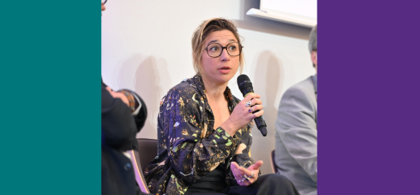
“Artificial Intelligence helps me set higher standards”
30/05/2025
Can artificial intelligence be used in the service of academic excellence? A Humanities teacher answers.
NEOMA’s world

Published on 16/03/2026
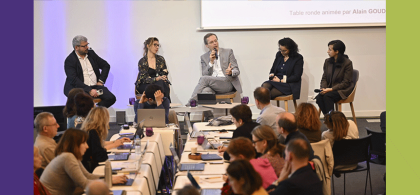
Training students to reproduce knowledge that AI can generate in a couple of seconds — does that still qualify as teaching? This was the question NEOMA brought to the table at its second AI, Higher Education and Research event on the Paris campus on March 10. After three hours of debate, three key takeaways emerged.
1. “Substitute AI” erodes skills — we need to learn how to use “confrontational AI”
Aurélien Fénard, Director of Digital Transformation and HR Data Governance at France Travail, made a clear distinction between the two approaches: “Substitute AI does the work for you, meaning you’re not growing your skills or becoming more independent. With confrontational AI, you do your research, organise your work, read a few books and articles, and make a first draft. Then you give your assignment or study to the AI and ask it to analyse what you’ve written critically, play devil’s advocate, dismantle your argument and find even stronger studies. When you use confrontational AI, you sharpen your skills and become more autonomous.”
“The top business schools that teach how to use AI as a sparring partner, rather than as a tool for writing their assignments, give their students a major competitive advantage.”
“We have to keep hold of our technical skills, otherwise we’ll be powerless down the line.” Students who outsource all their thinking to AI develop what Fénard calls the “ghostwriter effect”: the illusion of understanding concepts they have never actually learned.
2. AI hides a dependency that future managers need to understand
This issue is frequently overlooked in educational debates, yet it is one of the most important strategic challenges. According to Aurélie Simard, an expert in international AI governance, using AI today is a bit like leaving home to move into “a hyper-modern, fully furnished rental apartment with lots of wonderful mod-cons.” It’s very comfortable — until the day “the rules change and, overnight, you can’t get into your data anymore.”
Everyday conversational assistants and generative tools rely on a huge infrastructure — from chips and software standards to the data centres that run them — which is concentrated in the hands of a small group of US and Chinese actors. Companies that roll out these technologies without assessing the dependence they create risk surrendering control of their data, their processes, and sometimes even their business models.
This means the managers of the future cannot afford simply to be competent users of AI; they will also need to ask the right questions: Who owns my data? What are the consequences if the tool is discontinued or its terms of use change? Are there any sovereign alternatives? Training people to use AI also means teaching them to develop a critical mindset that distinguishes smart adoption from forced dependence.
3. The world of work is set to transform at breakneck speed — and business schools need to relearn how they train tomorrow’s leaders
Alain Goudey, NEOMA’s Deputy Director General, wrapped up the event with a staggering figure: “The World Economic Forum says that one billion jobs are expected to undergo major transformation by 2027. There simply aren’t enough of us in the education and training sector to support one billion people in such a short timeframe. It’s not a bad idea to work together, share best practices and move a bit more quickly.”
Now is not the time to hang around, and NEOMA hasn’t waited: “We’ve trained everyone. We began very early, in 2023, and haven’t just worked with our students but also 90% of our professors.”
What is at stake here goes far beyond updating the curricula. It reflects a deeper conviction, summarised by Alain Goudey: “AI must be approached as an organisational culture, not as a peripheral add-on. It is the very culture of the institution that needs to be rethought.”
Delphine Manceau, Dean of NEOMA, put it like this: “The issue isn’t how AI will influence the classroom, since AI is already in the classroom. Our students use it. They do their homework with it, and they prepare their lessons with it.” The real question, according to Manceau, is how to make AI a catalyst for excellence, fairness and competitiveness.
30/05/2025
Can artificial intelligence be used in the service of academic excellence? A Humanities teacher answers.
18/04/2025
NEOMA and APHEC brought together teachers from preparatory courses to explore artificial intelligence.